
What the research says
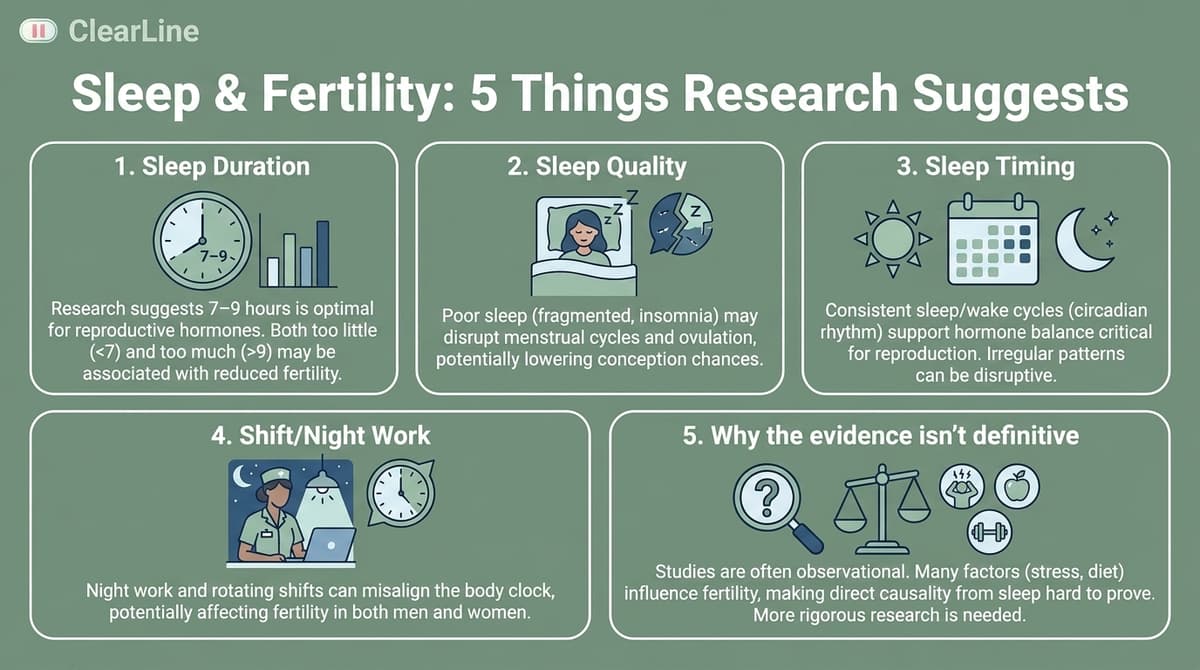
Research has found associations between sleep duration, sleep quality, sleep timing (chronotype), and reproductive outcomes, but the evidence is not definitive. Most studies are observational, so they cannot prove that poor sleep directly causes infertility.
A 2021 systematic review of 33 studies concluded that short sleep, evening chronotype, and shift or night work may affect reproductive function, natural fertility, and IVF outcomes, while also emphasising substantial differences between studies. See Caetano et al. (2021).
A 2024 systematic review by Li et al. found associations between sleep disturbances and female infertility and fertility treatment outcomes, and called for further longitudinal research. A 2022 meta-analysis found an association between 7 hours of sleep or less and fertility compared with 8 hours, rated the evidence as moderate, and noted the need for further research.
What is the relationship between sleep and fertility?
Sleep and fertility are linked in research through hormones that also govern ovulation, sperm production, and circadian rhythm, the body's internal clock. Melatonin, luteinising hormone, and cortisol all follow daily patterns. When sleep is short, fragmented, or mistimed, those patterns can shift.
How sleep affects fertility is still being studied. Associations do not mean that a bad week of sleep explains a negative test, or that perfect sleep guarantees conception. Age, ovulation timing, sperm health, and medical conditions remain the main drivers of time to pregnancy. For the bigger picture, see how to increase fertility naturally and how long it typically takes to get pregnant.
This sleep and fertility quiz is a way to notice patterns such as duration, regularity, night waking, bedtime, shift work, and daytime sleepiness. It is not a fertility score.
How much sleep should you get when trying to conceive?
Adults are generally advised to aim for about 7 to 9 hours of sleep in 24 hours. That is a general health recommendation, not a fertility prescription. There is no proven number of hours that guarantees a better chance of pregnancy.
How many hours of sleep for fertility is a common search, and the research is more cautious than headlines. [Zhao et al. (2022)](${REF.zhaoSleepFertility2022.url}) found an association between 7 hours of sleep or less and fertility compared with 8 hours, with moderate quality evidence and a call for more research. Sleeping much more than 9 hours was not clearly better either.
Sleep while trying to conceive is often disrupted by stress, early alarms for ovulation tests, or logging basal body temperature. Protecting a regular window of sleep still matters for energy, mood, and sustainable tracking, even when a specific hour count is not magic.
Can lack of sleep affect fertility?
Can lack of sleep affect fertility? Short sleep has been associated with differences in reproductive hormones, menstrual patterns, and, in some cohorts, time to pregnancy. That is an association: people who sleep less may also have more stress, different work hours, or other health factors that affect conception.
Sleep and trying to conceive often collide during the two week wait, when worry and checking your phone at night cut into rest. Lack of sleep is worth improving for wellbeing. It is not a diagnosis of infertility, and a short stretch of poor sleep does not mean you cannot conceive.
If you are timing tests, first morning urine is still the usual advice for early testing, which is easier when you actually slept. Use the DPO calculator and should I test today? quiz rather than testing at 3am after a broken night.
Does sleep quality matter for fertility?
Sleep quality and fertility show up together in several studies of trouble staying asleep, insomnia, and fragmented nights. Schliep et al. found that frequent trouble sleeping was associated with modestly lower fecundability (the chance of conceiving in a given cycle) in a large North American preconception cohort. Shift work in that study was not clearly linked to fecundability.
Waking often, snoring, or never feeling restored can matter even if total hours look adequate. Poor sleep can also make BBT charts harder to read, because night waking and later rise times distort morning temperature.
If nights are broken most of the week, treat that as a health issue in its own right. A GP can screen for insomnia, sleep apnoea, thyroid problems, or mood conditions that affect both sleep and cycles. Our is my cycle normal? quiz can help you describe cycle patterns alongside sleep.
Does shift work affect fertility?
Does shift work affect fertility? Findings are mixed. Some reviews group night and rotating shifts with evening chronotype as possible risk markers for reproductive function. Other prospective studies find little or no association between shift work and time to pregnancy.
Freeman et al. looked at preconception sleep duration, sleep timing, and shift work among women with a history of pregnancy loss and did not find a strong overall link with fecundability or live birth. Night work in other datasets has been associated with slightly different odds, often with wide confidence intervals.
If you work nights, conception is still possible. Flexible ovulation tracking with OPKs and cervical mucus rather than clock time often helps more than forcing a daytime schedule you do not have. The fertility window calculator and ovulation calculator can still give a starting estimate from cycle length.
Tips for better sleep while trying to conceive
Sleep while trying to conceive does not require a perfect routine. Aim for a consistent bedtime and wake time, including weekends when you can. Keep the bedroom dark, cool, and quiet, and park ovulation test photos and pregnancy test zooming outside the last hour before bed.
Caffeine late in the day, heavy evening meals, and bright screens can delay sleep. Gentle movement helps many people; exhausting late workouts may not. If you chart BBT, take the reading at a consistent time and note night shifts or broken sleep rather than discarding the whole cycle.
Protect the fertile window with intercourse timing you can sustain, not with all night worry. Fatigue in early pregnancy is common later on. See fatigue in early pregnancy. Before a positive test, rest is still ordinary self care, not a fertility treatment.
When should you speak with a healthcare professional?
Talk to a GP or sleep clinician if you have persistent insomnia, loud snoring or pauses in breathing, falling asleep unintentionally, or sleepiness that affects work or driving. Those issues deserve care whether or not you are trying to conceive.
For fertility concerns, typical guidance is to seek review after about 12 months of well timed trying if you are under 35, or after about 6 months if you are 35 or older. Seek review sooner if cycles are very irregular, periods have stopped, or you already know a medical factor. Read how long to get pregnant and female infertility signs.
Bring notes: typical hours of sleep, shift pattern, night waking, and cycle length. Better sleep is a worthwhile health goal. This quiz still cannot tell you whether your sleep is causing or preventing pregnancy. Only a clinician can assess fertility in context.
Frequently Asked Questions
Can lack of sleep affect fertility?
Short or disrupted sleep has been associated with differences in reproductive hormones and, in some studies, time to pregnancy. That is not the same as proof that lack of sleep causes infertility. Many other factors, including age, ovulation, and sperm health, matter more. See how to increase fertility naturally.
How many hours of sleep for fertility?
There is no guaranteed number. General adult guidance is about 7 to 9 hours. A 2022 meta-analysis found an association between 7 hours of sleep or less and fertility compared with 8 hours, with moderate quality evidence. More hours than 9 is not clearly better. Treat sleep as health support, not a fertility dose.
Does sleep quality matter when trying to conceive?
Sleep quality and fertility appear together in studies of trouble staying asleep and insomnia. Frequent night waking was linked with modestly lower per-cycle conception chances in one large preconception cohort, while findings on shift work were mixed. Broken sleep is also a common reason BBT charts look messy.
Does shift work affect fertility?
Research is mixed. Some reviews flag night and rotating shifts as possible concerns; several prospective studies find little association with time to pregnancy. Night work can still make ovulation tracking harder. Flexible OPK timing often helps more than assuming shift work makes conception impossible.
Can this sleep and fertility quiz tell me if I am infertile?
No. This quiz only comments on sleep habits. It cannot diagnose infertility, calculate a fertility percentage, or say whether sleep is preventing pregnancy. If you are worried about time to conception, read how long to get pregnant and speak with a healthcare professional.
How should I sleep during the two week wait?
Sleep as regularly as you reasonably can. The two week wait often disrupts rest because of symptom checking and early testing. Protecting sleep supports mood; it does not implant an embryo. Plan a test date with when to take a pregnancy test instead of testing through the night.
Sources & Evidence
- Caetano et al. - Impact of sleep on female and male reproductive functions: a systematic review (2021)
- Li et al. - Sleep disturbances and female infertility: a systematic review (2024)
- Zhao et al. - Effects of physical activity and sleep duration on fertility: a systematic review and meta-analysis (2022)
- Schliep et al. - Female sleep patterns, shift work, and fecundability in a North American preconception cohort study
- Freeman et al. - Preconception sleep duration, sleep timing, and shift work in association with fecundability and live birth among women with a history of pregnancy loss
This sleep and fertility quiz is educational only. It assesses sleep habits, not fertility. It cannot determine whether you can get pregnant, diagnose infertility or any other medical condition, or tell you whether your sleep is causing or preventing pregnancy. Better sleep is a worthwhile health goal. Speak with a healthcare professional about persistent sleep problems or concerns about trying to conceive.