Find the cycle day to start ovulation tests
Get a start day, how many strips to pack, and a day by day testing plan. This is different from an ovulation date estimate.
Enter your cycle details
Range: 21 to 38 days
iOS + Web
Read ovulation tests with ClearLine
Photograph an ovulation test and let ClearLine AI read the line in seconds on web or iOS.

Web + iOS · Subscription required
How ovulation predictor kits work
Ovulation predictor kits look for luteinising hormone in urine. LH rises shortly before the ovary tries to release an egg. A test line as dark as the control is the usual definition of a surge. That rise is a timing clue for sex in the next 24 to 36 hours, not a confirmed ovulation event.
Learn more in how ovulation tests work and LH surge and ovulation. You can also photograph strips with the ovulation test reader.
When should I start ovulation tests?
A simple rule is to start about 17 days before your next period. Cycle day 1 is the first day of full flow. On a 28 day cycle that start day is cycle day 11. Shorter cycles start earlier, with a floor of cycle day 8 so you are not testing through your period.
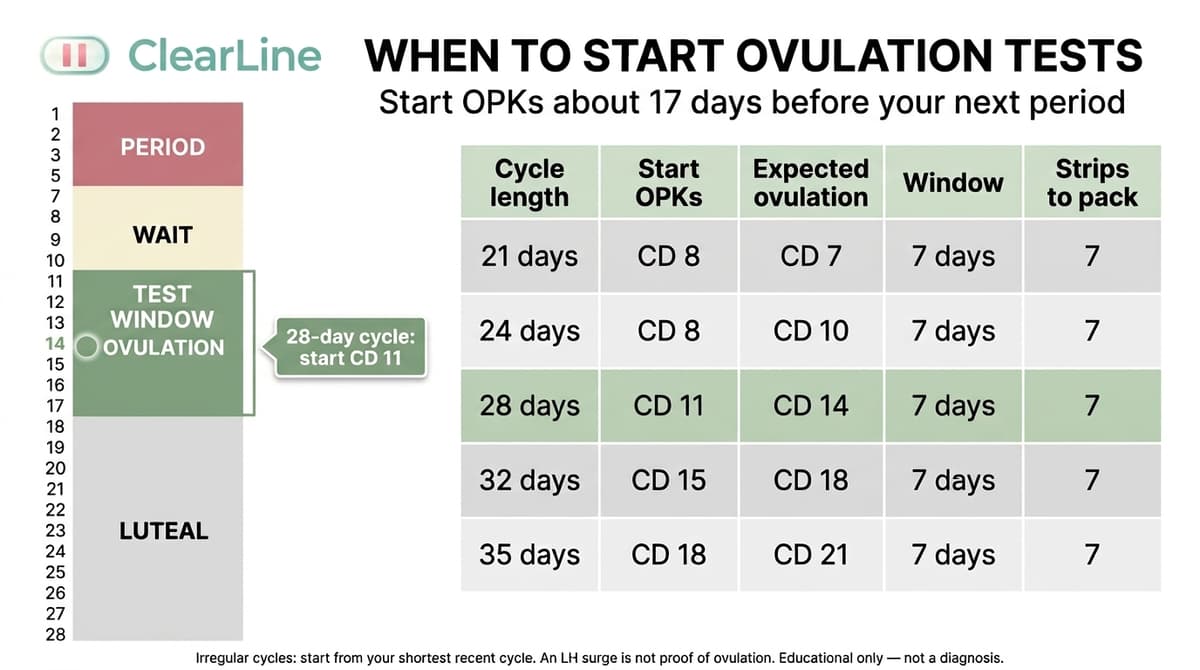
| Cycle length | Start day | Expected ovulation | Strips to pack |
|---|---|---|---|
| 21 days | Cycle day 8 | Cycle day 7 | 7 if regular |
| 24 days | Cycle day 8 | Cycle day 10 | 7 if regular |
| 28 days | Cycle day 11 | Cycle day 14 | 7 if regular |
| 32 days | Cycle day 15 | Cycle day 18 | 7 if regular |
| 35 days | Cycle day 18 | Cycle day 21 | 7 if regular |
Irregular cycles and PCOS
If cycle length varies a few days, use a 10 day testing window. If cycles are irregular, use the shortest recent cycle for the start day and a 14 day window. PCOS and PMOS can show extra LH peaks, so the first positive is not always the only fertile day. Pair OPKs with another sign when you can.
How to test for an LH surge each day
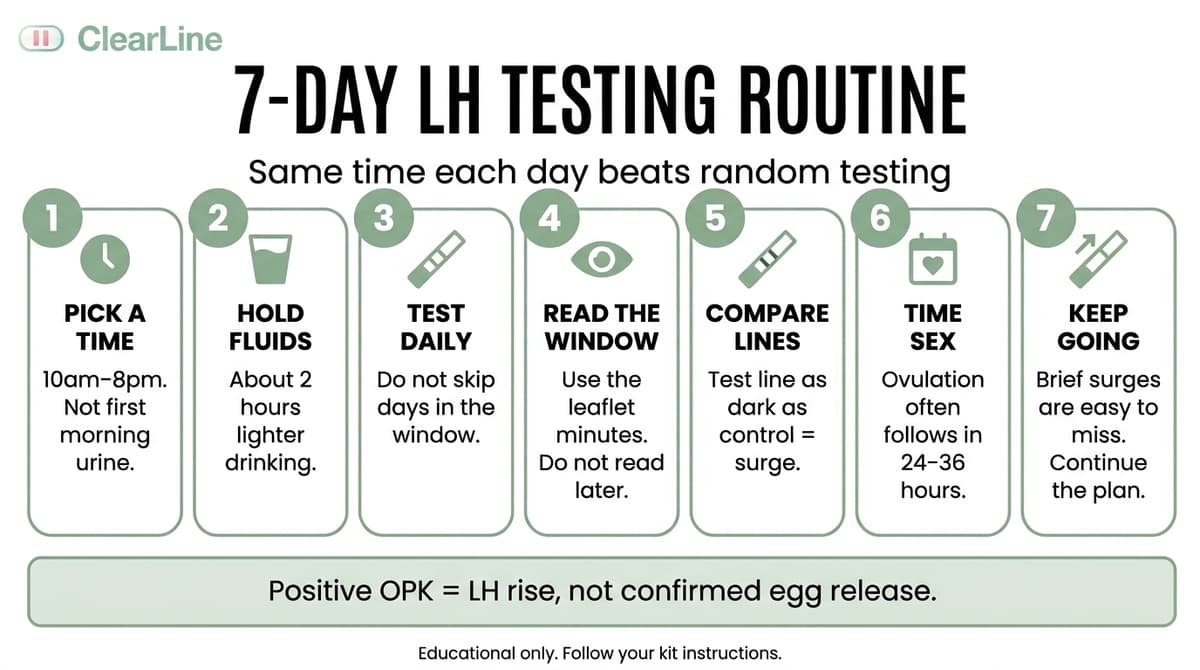
Choose one afternoon time between 10am and 8pm. Hold fluids for about two hours. Read the strip inside the leaflet time. Keep testing after a positive if you often see short surges, or switch to twice a day near the expected peak.
What a positive ovulation test means
A positive means LH rose. Time sex for the next day and a half, then keep living your life. If you never see a surge, try the LH test troubleshooter or plot readings in the OPK surge predictor.
How this differs from the ovulation calculator
The ovulation calculator estimates ovulation as cycle length minus 14. This start day tool answers a different question: when to open the first strip so a short peak is less likely to slip past you.
Frequently Asked Questions
When should I start ovulation tests on a 28 day cycle?
On a 28 day cycle, start OPKs on cycle day 11. That is about 17 days before your next period. Test daily until you see a surge, or through a 7 day window if cycles are regular.
Should irregular cycles start OPKs earlier?
Yes. If cycles jump around, use your shortest recent cycle to pick a start day so testing begins earlier. Pack a longer window, often 10 to 14 days, and consider testing twice a day near the expected peak.
Is first morning urine best for ovulation tests?
Not for most OPKs. First morning urine is for pregnancy tests. LH often shows more clearly in the afternoon. Pick one time between 10am and 8pm, hold fluids for about two hours, and read the strip in the leaflet window.
Does a positive OPK mean I ovulated?
No. A positive ovulation test means luteinising hormone rose. The egg is usually released about 12 to 36 hours later, but a surge is not proof that an egg left the ovary.
How is this different from an ovulation calculator?
An ovulation calculator estimates the fertile window from cycle length. This tool tells you which cycle day to start testing so you are less likely to miss a short LH peak.