
Convert AMH from pmol/L to ng/mL
See both units, the 7.14 formula, and a soft reading for age. Bring the range on your printout to clinic.
Enter your AMH result
Unit on the report
iOS + Web
Read ovulation tests with ClearLine
Photograph an ovulation or pregnancy test and get a line reading in seconds on web or iOS.

Web + iOS · Subscription required
What AMH measures
Anti Müllerian hormone is made by small ovarian follicles. A higher number usually means more remaining follicles. A lower number usually means a smaller pool. It does not measure egg quality, predict pregnancy next month, or set a menopause date.
Read the hub guide AMH and fertility and FSH levels and pregnancy for how clinics pair AMH with antral follicle count and age.
UK and EU units versus US units
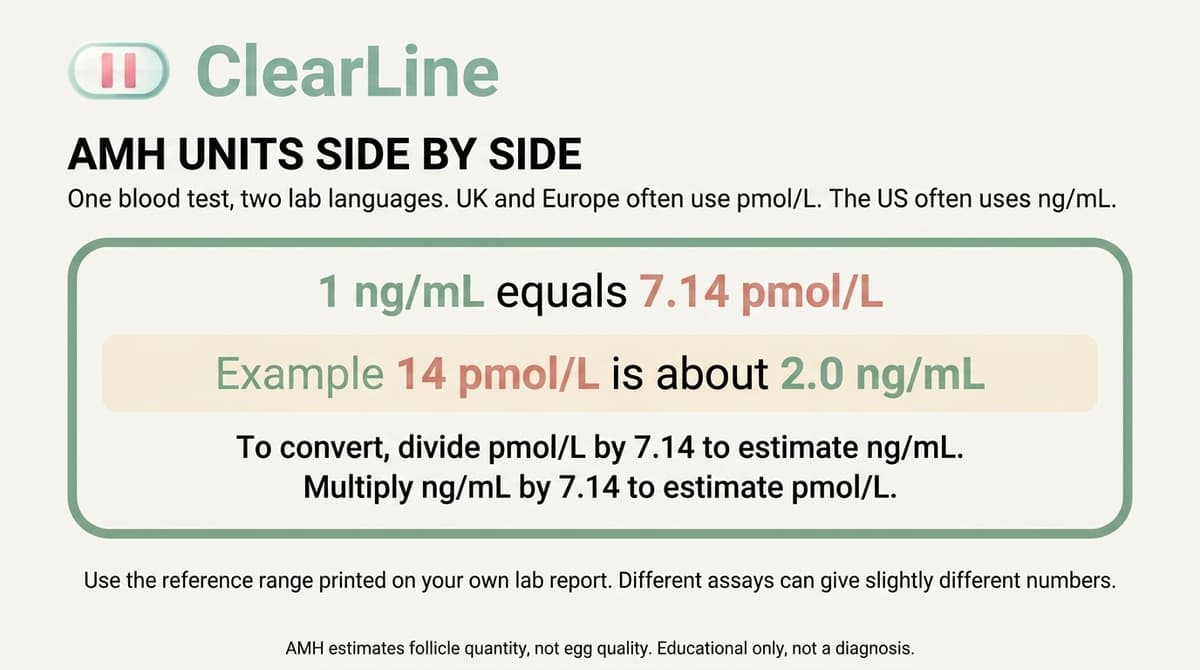
Many UK and European labs print pmol/L. Many US labs print ng/mL. Mixing them is a common forum panic. Convert both ways here, then ignore online charts that hide the unit.
Why 7.14 is an approximation
The factor 1 ng/mL equals 7.14 pmol/L comes from a Beckman style conversion used widely in fertility. Other assays, including some Roche kits, are not identical. Converted numbers help you talk to a clinician. They do not make two labs interchangeable. Same lab, same assay, over time, beats a converted forum screenshot.
Age versus quality
AMH estimates quantity. Age is still the stronger clue for chromosomal quality. You can have lower AMH at 32 and still have reasonable monthly odds, or typical AMH at 41 with a steeper quality decline. Egg freezing yield counselling uses both. See best age to freeze eggs and cost to freeze eggs.
High AMH and PCOS
Very high AMH can appear when many small follicles stall, which is common in PCOS. High AMH alone does not diagnose PCOS. Irregular ovulation, androgen signs, and scan appearance still matter. Tracking ovulation with OPK start day can help when cycles jump around. Photograph those tests so a surge is not a guess.
What to ask at clinic
Ask which assay was used, whether serial tests can stay at that lab, how AMH sits next to antral follicle count, and how stimulation or freezing plans would change. If you are heading toward IVF, learn how clinics quote success in the IVF success rate decoder.
Frequently Asked Questions
How do I convert AMH pmol/L to ng/mL?
Divide pmol/L by 7.14. A result of 14 pmol/L is about 2.0 ng/mL. Multiply ng/mL by 7.14 to go the other way. This Beckman style factor is widely used in fertility, but assays still differ, so same lab serial tests beat converted forum charts.
Is AMH of 12 pmol/L low?
12 pmol/L is about 1.7 ng/mL. Many charts would call that typical rather than very low, but age, antral follicle count, and the lab printed range matter more than a forum table. This tool cannot grade ovarian reserve.
Why do UK and US AMH numbers look so different?
UK and many EU labs report pmol/L. US labs often report ng/mL. The same biology can look seven times larger or smaller if you mix units. Always check the unit on the printout before comparing.
Does high AMH mean I will conceive easily?
No. High AMH can appear with PCOS, where many small follicles make hormone but ovulation is irregular. Quantity is not quality, and AMH does not predict next month pregnancy.
Can ClearLine read my AMH blood test?
No. ClearLine reads home pregnancy tests and ovulation tests from photos and helps you track a cycle. Take the AMH printout to a clinician.